
News
UK phishing detections climb as familiar senders test email defences
A finance team asks IT to let a supplier’s signing requests through after a contract gets stuck in quarantine. Months later, who remembers why the exception exists? Two November reports make that a timely question. Proofpoint recorded a sharp rise in UK phishing detections, while Microsoft found that existing mail rules frequently overrode security decisions on messages impersonating business services.
The UK figures deserve a closer look
On 18 November, Proofpoint reported that it detected 5.7 times as much phishing activity in the UK as a year earlier. The corresponding figures were 4.5 times across Europe and 1.5 times globally. Higher education was the UK sector most targeted by phishing in its observations. These figures measure what Proofpoint detected. They tell a university IT team something about the pressure on its inboxes, but a detection count alone cannot tell it how many accounts were compromised. Proofpoint’s UK threat report
For a managed service provider preparing a customer review, put three numbers side by side: messages flagged, messages delivered after an exception, and confirmed incidents. A rise in the first figure calls for a different conversation from a rise in the second. The third tells the customer where someone actually had to investigate and recover an account.
October 2026 volume as a multiple of October 2025 volume. A value of 1× means no change. Each bar uses the same 0–6× scale.
The fourth bar helps answer a question a finance director might ask: did detections rise simply because more email came in? In Proofpoint’s UK data, overall email volume rose to 1.5 times its previous level. Phishing detections grew much faster. Dividing 5.7 by 1.5 gives about 3.8: for the same volume of UK email, Proofpoint recorded roughly 3.8 times as many phishing detections as a year earlier. That comparison describes the mail Proofpoint observed. An individual business can make the same calculation using its own inbound volumes and a consistent definition of a detection.
What UK organisations see in their own inboxes
A supplier can send a hundred suspect messages to one organisation, and a gateway can count all hundred. A survey asks a different question: how many organisations recognised at least one attempt? The UK government’s Cyber Security Breaches Survey adds that perspective. It also asks whether organisations have agreed who should hear about an incident. That second question matters when a colleague has a questionable invoice open and a payment run is due.
Percentage of all UK businesses and charities surveyed in 2025/26 with written guidance on whom to notify. Bars are scaled from 0 to 100%.
Try a five-minute exercise with the person covering accounts payable on a Friday afternoon. Give them a fictional change-of-bank-details request and ask them to find the reporting instructions they would actually use. Can they identify who can put the payment on hold, who checks the email, and who calls the supplier on a number already in the supplier record? If they need to ask the colleague who is on leave, there is a specific gap to fix. Put the contact route beside the payment procedure and repeat the exercise with the next person on cover.
The exception behind the signing request
Microsoft’s 5 November report counted roughly 129 million malicious messages impersonating the business-service domains it tracked in the third quarter. Among September messages in that group for which Microsoft recorded a security outcome, 63% had an override at the organisation or user level. Organisation-wide settings accounted for most overrides. The 63% figure measures how often an exception applied. It cannot establish how many people opened a message. Microsoft’s Q3 email threat report
That makes an old allow rule a good place to start. Pick one that covers a signing or invoicing service. Ask the business owner for a recent genuine message, then ask the mail administrator which senders the rule actually admits. If a single supplier needs the exception, the administrator should be able to explain why it also applies to anyone else. Test a narrower rule against genuine mail before changing it. Spambrella’s mail flow guide shows where allow rules take effect.
September 2026, malicious messages spoofing tracked business-service domains for which Microsoft recorded a security outcome. Bars are scaled from 0 to 100%.
For the signing-service example, reconstruct one real delivery with the contract owner. Start with the request they were expecting: who initiated it, which agreement it concerned and where they normally find outstanding documents. Then follow the same message through the mail logs. Record the original filtering decision, the rule that changed it and the final destination. A message marked as suspicious and then delivered needs a different follow-up from one that stayed in quarantine until someone deliberately released it.
Give the exception an owner and a review date. At the review, ask the owner to demonstrate the workflow again. A supplier may have moved to a different signing platform while the old exception stayed in place. If the workflow is still active, document a genuine test message and agree who will check that the next expected request arrives. This gives the administrator a way to tighten the rule without leaving the contracts team guessing whether a missing signature request is late or quarantined.
QR phishing fell, but the staff briefing still matters
Microsoft also recorded 12.1 million QR phishing attacks in Q3, down 67% from the previous quarter. PDFs still accounted for 61% of those attacks in September. For someone opening a PDF on a work laptop, scanning the code can move the next step to a personal phone. Microsoft’s findings on QR phishing
Use this QR phishing example in your next security awareness training session. Give staff a concrete instruction for that moment. If an unexpected document asks them to scan a code to sign in, they can open the service from their usual bookmark, check for the document there, and report the original email if they cannot verify it. For the next customer review, walk through that example alongside one real mail exception. Together they show exactly where the mail administrator and the recipient each have a decision to make.
What to bring to the next customer review
Use the same reporting period for inbound mail, detections and deliveries. For example, if a customer received 100,000 messages in one month and 250 were flagged as phishing, the rate was 25 detections per 10,000 inbound messages. If both counts double the following month, the rate stays at 25. The queue may need more people to review it, but the figures alone would give the customer little reason to conclude that a greater share of its mail was malicious. Label any change to the mailboxes covered or the filtering policy alongside the figures.
End the review with one decision the customer can check next month. For a finance team, that might be assigning an owner to the signing-service rule and verifying the next legitimate contract request. For a university help desk, it might be asking a staff member to report a suspicious QR document from the device they normally use, then confirming the help desk received the original message. Write down who will check the result and what evidence they will bring back. A delivery trace or a report received by the right team tells you more about the control than another slide of blocked-message totals.
Further reading

QR code phishing and email filters

How Spambrella processes inbound mail

Security awareness training

Anti-phishing protection
Get Started with Spambrella
Protect your business email with enterprise-class filtering, continuity, and archiving.


Latest Blog Posts
Spambrella joins Anthropic’s Cyber Verification Program
Spambrella has been accepted into Anthropic’s Cyber Verification Program, which lets vetted security organisations use Claude for defensive work its cyber safeguards block by default.
A supplier says their bank details have changed. How do we check before the payment run?
A supplier emails new bank details days before your payment run. Here is how to spot payment-redirection fraud, which email security controls help, and the checks finance should…
What is prompt injection, and can we build defences?
An IT manager asks an AI assistant to summarise a supplier’s email before a change meeting. The summary says the supplier has approval to go ahead. The manager…
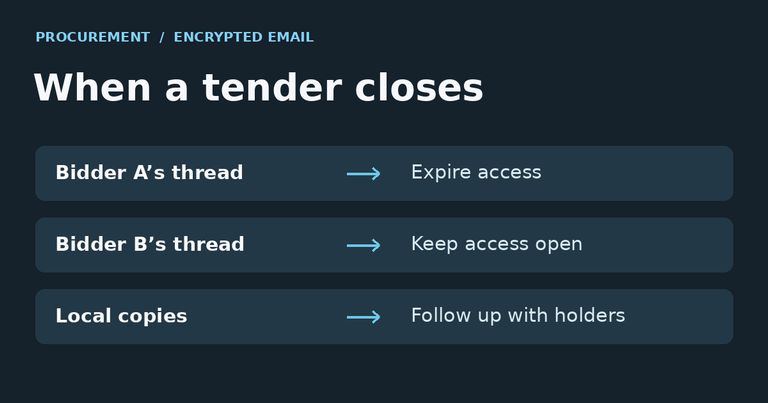
Can we withdraw a bidder’s access to an encrypted tender email?
At ten on Monday morning your surveyor tells you that a different contractor has won the job. The unsuccessful bidder already has an encrypted email with the site…
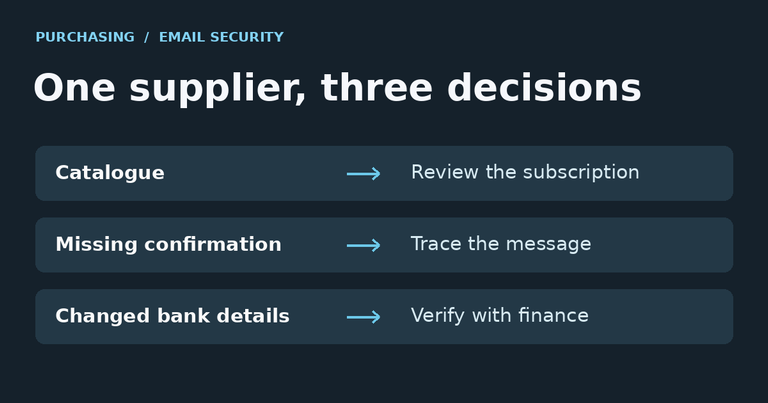
How can we keep newsletters out of a shared inbox without missing supplier orders?
A supplier sends its winter catalogue and your order confirmation to the same purchasing inbox. The catalogue can wait until Friday. The confirmation gives you until noon to…

How do you verify an email archive migration before retiring the old system?
The old archive contains 14 copies of a supplier’s quotation. The new archive returns one. Has the migration lost 13 records, or has it correctly stored one message…

How can you test email continuity without disrupting customer mail?
At 09:10 on a Monday, a customer rings to move a delivery from the morning to the afternoon. Your dispatcher says they never received the email. Outlook is…

After Securence: How to check your email migration
If you rely on Securence for email filtering, hosted Exchange, or continuity services, it’s time to start planning your exit. Securence’s parent company, US Internet (USI), has confirmed…
Get a quote…