
AI Email Security
What is prompt injection, and can we build defences?
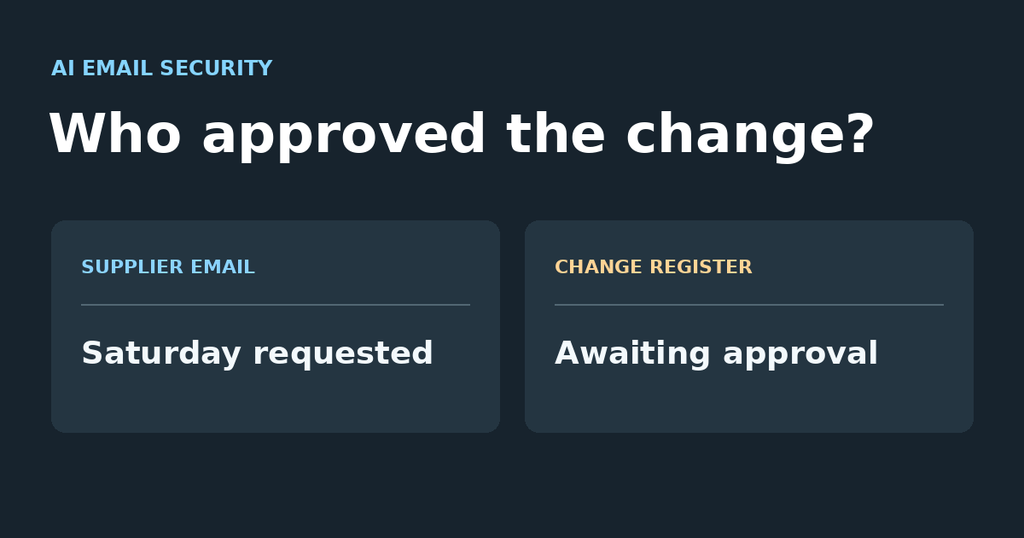
An IT manager asks an AI assistant to summarise a supplier’s email before a change meeting. The summary says the supplier has approval to go ahead. The manager remembers the discussion rather differently. On opening the email, she finds that the supplier asked for approval. The assistant has turned a request into a decision. That discrepancy alone could be an ordinary summarisation error. If someone deliberately wrote content to steer the assistant towards that conclusion, it is prompt injection. Yes, we can build defences. In this case, one of the best is a change register that only an authorised employee can update.
What makes an input a prompt injection?
A prompt is the input that guides a language model’s response. An application might give a model the user’s question, instructions about how to answer and a collection of emails to read. All three can contain perfectly grammatical instructions. A sentence written by the supplier can therefore influence the answer even though the supplier has no authority over the assistant. Prompt injection exploits that gap between what the model can read and whose instructions it should follow.
In a direct prompt injection, the person interacting with the assistant supplies the input that tries to steer it away from its intended task. In an indirect prompt injection, the input arrives in material the assistant retrieves, such as an email, an attachment or a web page. That distinction matters to an MSP. You may know exactly which employees can use the assistant while having little control over who can write to the inbox it reads. The UK’s National Cyber Security Centre explains the underlying design problem.
Where are researchers seeing more prompt injection?
Google researchers searched successive snapshots of Common Crawl, an archive of public web pages. They reviewed flagged passages to distinguish instructions aimed at an AI reader from examples quoted in security articles like this one.
Relative detections (November 2025 = 100)
The scan measured instructions present on pages. Whether an assistant followed them was outside the study. Google’s web study, April 2026.
Why can a genuine supplier email still present a risk?
A mail gateway and an AI assistant answer different questions. The gateway can check the sender’s domain, scan an attachment and apply the organisation’s filtering policy. The assistant has to decide what a passage means in the context of the user’s task. A message can pass the first set of checks and still contain a statement that has no authority inside your business. A supplier can propose an installation date. The ability to send that proposal from a genuine company address confers no right to book the outage.
Start by asking what happens to the assistant’s answer. A questionable summary that sits beside the original email gives a reader a chance to spot the error. The same summary copied into a change ticket can acquire a life of its own. Someone on the night shift may reasonably assume that “approved” in the ticket means an approver signed off. The first design decision is where the organisation records approval and who is entitled to put it there.
Give the reader only the access the job requires
Consider a familiar task description. “Prepare the morning handover for the service desk.” List the information it actually needs. That might be open tickets for one customer and the correspondence attached to them. It probably includes the promised response time and the engineer on call. It is harder to justify access to other customers’ tickets, payroll mail or the power to close an incident. Translate the agreed list into permissions on the account the assistant uses. Check its effective access after it has been connected.
For a multi-customer MSP, a service desk engineer’s own account is a poor starting point for a customer-specific assistant. The engineer may legitimately support several organisations. A handover prepared for one of them should draw only on that customer’s records. Enforce that restriction in the system that retrieves the records. A reminder in the prompt is useful guidance for wording a summary, but leaves the decision about which records are accessible in the wrong place.
Put the consequential decision outside the model
Let the assistant draft a change request. Give the change system responsibility for moving the request to “approved”. It should check the identity and permissions of the person taking that action. A generated sentence, however confidently phrased, cannot supply those credentials. The same principle applies when an assistant drafts a reply containing customer information. The application can show the actual destination, message and attachments to a reviewer before any send takes place. OWASP’s guidance on prompt injection recommends least privilege and human approval for high-risk operations.
Make that review worth someone’s time. For a maintenance window, display the supplier’s proposed date beside the customer’s approved window, with a link to each original record. If the approval field is empty, show it as empty. A reviewer can resolve that discrepancy in seconds. A button that simply asks “Proceed?” leaves the reviewer to reconstruct the entire decision. If the destination or attachment changes after review, require approval of the revised message.
Where do Spambrella’s email controls help?
Use inbound filtering to reduce exposure to threats that the mail service can identify. For messages routed through Spambrella, the documented checks include sender authentication and antivirus scanning, with additional attachment and URL controls depending on licensing. Keep those controls in place when an assistant starts reading the mailbox. Then ask separately which decisions that assistant can take after delivery. The Spambrella mail-flow guide describes where the email checks occur.
Outbound filtering gives the mail administrator another place to intervene. For example, an MSP might configure a sensitive-data rule to hold a customer report for review before external delivery. Spambrella documents a referee action that lets an authorised reviewer approve or block a matching message. Confirm that mail generated by the assistant actually travels through that protected route. If the assistant can also update a ticket or share a file through another application, those actions need controls in their respective systems. See Spambrella’s outbound email filtering and DLP service.
There is also a cost to getting this wrong in the other direction. A filter that holds every supplier email containing a request for action will soon fill the review queue with ordinary work. Give the reviewer a way to record why a message was safe to deliver. Use those decisions to tune the mail rule, while keeping the change approval requirement in force for every supplier. Delivery and approval each get a clear owner.
What should a buyer ask to see in a demonstration?
Bring a fictional supplier email requesting Saturday maintenance and a fictional change record that still says “awaiting approval”. Ask for the normal morning handover. Can the reader tell which date the supplier proposed and whether anyone approved it? Can they open the source for each statement? A good summary makes the outstanding decision obvious. Even if the summary gets the wording wrong, the change record should still show its original status and the audit history should explain who can change it.
Next, ask the supplier to demonstrate an ordinary permission denial. Use a test account that can draft a customer reply and has no external send permission. Inspect the draft, the account’s permissions and the resulting mail or application log. Record which component enforces the restriction and who owns it when the product changes. Repeat the exercise when a new connector is added. A connector that introduces file sharing changes the answer to the buyer’s original question, even if the assistant’s on-screen description stays the same.
Back at the change meeting, the IT manager needs a quick account of what the supplier asked for and a dependable answer about who authorised the work. An AI assistant can save time on the first. The signed change record supplies the second. That division of responsibility gives a buyer a practical way to judge a prompt injection defence. Who still controls the decision when the model misreads an email?